Why Is the Sky Blue?
Why Is the Sky Blue?
Few questions show up as reliably as why is the sky blue. Kids ask it on car rides, during walks, or while lying on their backs in the grass. Adults often answer with a vague “it has to do with light,” and then trail off. The good news is that the real explanation is both beautiful and very teachable—if we slow it down and meet kids where they are.
This article focuses on the science behind why the sky is blue, but always through a parent-friendly lens. You don’t need physics training. You just need a clear picture, a good analogy, and permission to keep it simple.
The Short Answer (For When You’re in a Hurry)
If a child asks why the sky is blue, here’s a sentence you can use right away:
"Sunlight has lots of colors in it, and the air spreads the blue ones around the most."
That single sentence is accurate, age-appropriate, and enough for many kids. But if curiosity keeps bubbling up, let’s open it gently.
Sunlight Isn’t Just White
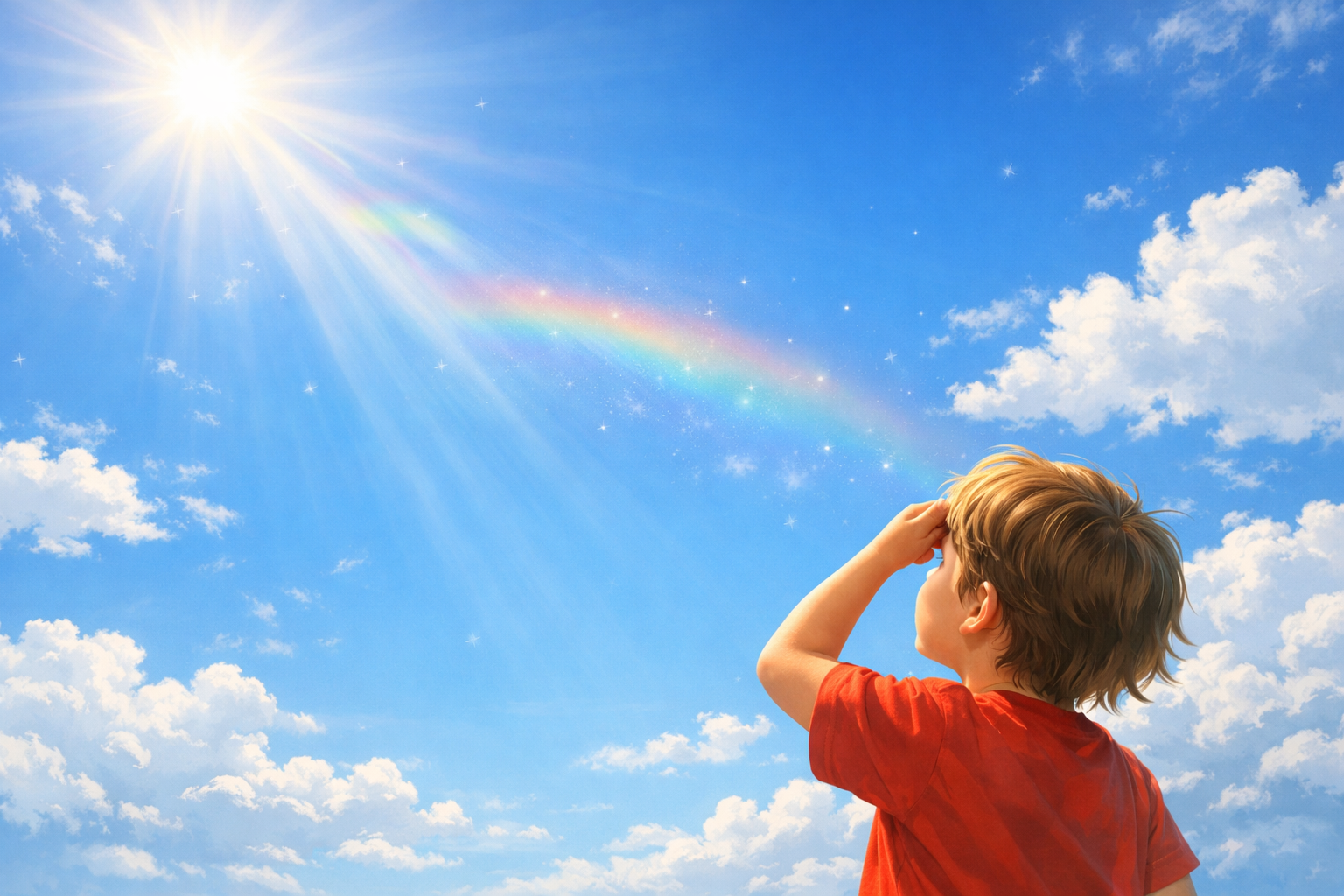
One of the biggest misunderstandings—among kids and adults—is that sunlight is just white. In reality, sunlight is a mix of all the colors we see in a rainbow: red, orange, yellow, green, blue, indigo, and violet.
You may have seen this with:
- Rainbows after a storm
- Light passing through a glass prism
- Sunlight hitting a CD or soap bubbles
All those colors are always traveling together inside sunlight, even when we can’t see them separately.
This matters because the answer to why the sky is blue begins with understanding that the sun sends many colors toward Earth at once.
What Happens When Sunlight Hits the Air
Between the sun and your child’s eyes is Earth’s atmosphere—a huge layer of air made of tiny gas particles. These particles are much, much smaller than the width of a human hair.
When sunlight enters the atmosphere, it bumps into these tiny air particles. That’s where things get interesting.
Some colors of light pass straight through. Some get absorbed. And some get scattered—sent bouncing in many directions.
Here’s the key idea:
Blue light scatters more than any other color.
That scattering spreads blue light all over the sky, in every direction. So no matter where you look—up, sideways, or toward the horizon—blue light is reaching your eyes.
That’s the core scientific reason why the sky is blue.
A Helpful Analogy for Kids
Analogies help children hold onto abstract ideas. This one works especially well:
Imagine sunlight as a big box of bouncy balls, all different colors.
The air is like a room full of tiny pins.
The blue balls are extra bouncy, so when they hit the pins, they bounce everywhere.
Soon, the whole room looks blue—not because there are more blue balls, but because they spread out the most.
You can swap “bouncy balls” for glitter, confetti, or bubbles depending on your child’s age and interests.
Why Isn’t the Sky Purple?
This is a smart follow-up question, and kids ask it often.
Violet light actually scatters even more than blue light. So why don’t we see a purple sky?
There are two main reasons:
- Our eyes are better at seeing blue than violet. Human vision is less sensitive to violet light.
- Some violet light gets absorbed higher up in the atmosphere.
What’s left—and what our eyes are best at noticing—is blue.
So when children ask why the sky is blue and not purple, the answer is partly physics and partly biology.
Why the Sky Changes Color
Talking about why the sky is blue naturally leads to noticing when it isn’t blue.
Sunsets and Sunrises
At sunset and sunrise, sunlight has to travel through much more atmosphere to reach us. Along the way:
- Most of the blue light scatters away
- Red, orange, and pink light keep going
That’s why the sky turns warm colors when the sun is low.
Cloudy or Gray Skies
Clouds are made of water droplets that scatter all colors of light more evenly. When everything mixes together again, the sky looks white or gray instead of blue.
These changes help kids see that the sky’s color isn’t fixed—it depends on how light and air are interacting at that moment.
A Simple Activity You Can Do at Home
Hands-on experiences make explanations stick.
Try this:
- Fill a clear glass or bowl with water
- Shine a flashlight through it in a dark room
- Add a drop of milk and stir gently
The milk particles scatter the light, and you’ll notice a bluish glow from the side—similar to how air scatters sunlight in the sky.
You can say:
"This is like a tiny sky in a bowl."
How Understanding Changes by Age
Children don’t all need the same explanation.
- Ages 3–5: “The air spreads blue light everywhere.”
- Ages 6–8: “Sunlight has many colors, and blue spreads the most.”
- Ages 9–12: Introduce scattering, vision, and why sunsets are red.
If a child seems satisfied, stop there. Curiosity can reopen the conversation later.
A Common Parent Pitfall
Many adults jump too quickly into technical terms like wavelength or Rayleigh scattering. While these ideas are real, they often overwhelm younger kids and shut down curiosity.
A good rule of thumb:
If the explanation makes the adult feel smart but the child feel confused, it’s too much.
Simple, accurate language builds understanding over time.
Coming Back to the Big Question
So, why is the sky blue?
Because sunlight carries many colors, and Earth’s air spreads blue light around more than the others. That blue light reaches our eyes from every direction, painting the sky overhead.
When children ask this question, they’re not just looking for facts. They’re learning that the world follows patterns—and that those patterns can be understood.
And that may be the most beautiful part of all.
Start explaining the world today
Join thousands of parents who use Little Answers to turn 'Why?' into a moment of connection.